Cerabone® is a ceramic bone substitute for permanent bone filling or reconstruction of aseptic bone defects.
Cerabone® is manufactured from bovine cancellous bone and is in its set-up and structure nearly identical to that of human bone.
Cerabone® is manufactured from bovine cancellous bone under consistently standardized conditions. By processing under high temperature for several hours (sintering > 1,200 °C), the interconnecting macro- and microporous hydroxyapatite ceramic system achieves a higher compressive strength than human trabecular bone.
Cerabone® has marginal differences in porosity and mechanical properties of human trabecular bone.
The porosity (macroporosity) of the ceramic varies between 65 – 80 Vol. % and the pores size lies within a range of approximately 100 – 1,500 μm.
Antartik Inject is an injectable bioactive and resorbable bone substitute, composed of calcium sulphate (50%), hydroxyapatite (50%) and plasticizing.
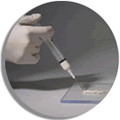
The product is supplied as two syringes (the first with liquid and the second with powder) which will be connected to mix the two components, different doses are available: 2 or 4 cc.
Jason® is a pH-neutral, wet-stable and resorbable collagen fleece that stimulates wound healing and serves as a haemostypticum.
The surface of the Jason® resorbable collagen fleece is populated with fibroblasts, making it an ideal medium for the adhesion of platelets and a reinforcement of the blood coagulation.
Jason®G is incrementally populated with gentamicin, giving the collagen fleece haemostatic properties and anti infective protection in contaminated areas.
The application of Jason® and Jason®G aims at the preserving the patient’s comfort: The fleece is resorbed within four weeks and does not need a second stage.
An osteoconductive haemostatic and absorbable collagen matrix
Characteristics
Bone ingrowth in 3 or 4 months
Hemostatic properties validated (tested by an outsourced laboratory)
Composition
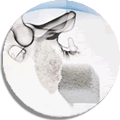
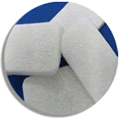
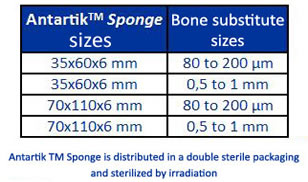
Antartik™ Sponge is a bone substitute made of hydroxyapatite and ß-tricalcium phosphate (ß-TCP).
Spread in a collagen matrix, type I and III.
For maxillofacial surgery and dental
Antartik™ Sponge is indicated for bone reconstruction
Indications
Antartik™ Sponge Antartik Sponge was designed to fill different types of bone defects, whether it is from surgical, traumatic or pathological origin. Specially in the following cases:
Bone sampling (compact-spongy bone sampling, tendon graft)
Synthetic bone substitute with antibiotic for prophylactic action.
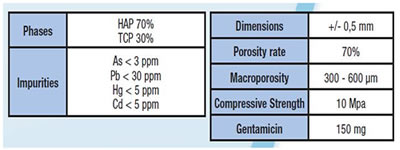
G-Fillinbone is composed of 70 % Hydroxyapatite and 30 % ß tricalcium phosphate. The composition of the materials complies with the prevailing standards.
It has been specially designed to fill in bone cavities for orthopaedic surgical operations (except contaminated surgery), in particular cases:
joint prosthesis,
spinal,
traumatology on closed fracture,
osteotomies,
Filling after tumour ablation.
It is strongly recommended when sensitive germs to gentamicin represent a risk.
Characteristics
G-Fillinbone bone substitutes are micro-porous and macro-porous. The macro-porosity has an average size of 500 µm and is totally interconnected. The bone substitutes G-Fillinbone have a porosity and optimised surface to allow the rapid bone ingrowth and a good osseointegration.
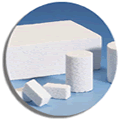
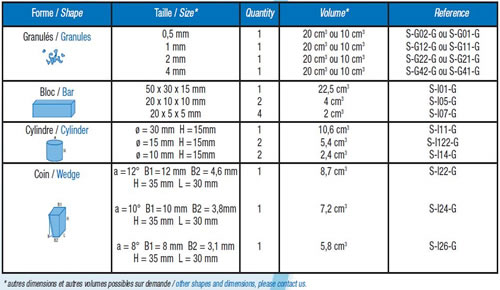
G-Fillinbone comes in bar, parallelepiped, corner, cylinder or granules form.
G-Fillinbone bone substitutes contain 150 mg of gentamicin stocked in the porosity of the implant:
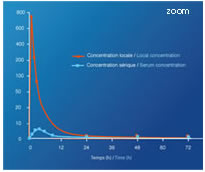
Its function is to prevent the patient from infection of the operated wound when infection by gentamicin sensitive germs is a potential risk. All the gentamicin contained in G-Fillinboneis released locally in the first hours after implantation. Releasing duration is less than 48 hours not to generate antibiotic resistant strains.
Fig.1. Local rate (=synovial liquid) and serum rate (=blood) of gentamicin after implantation of G-Fillinbone in the femur of a sheep (average on 5 sheep).
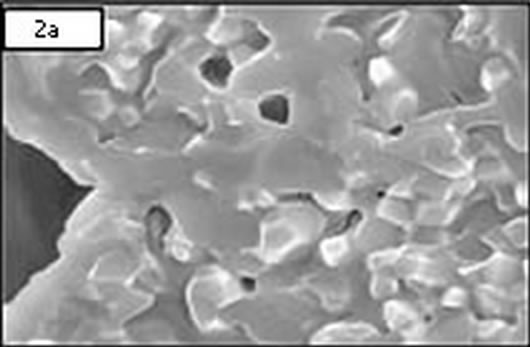
Fig. 2a : Microstructure of G-Fillinbone : the gentamicin is stored in microporosities
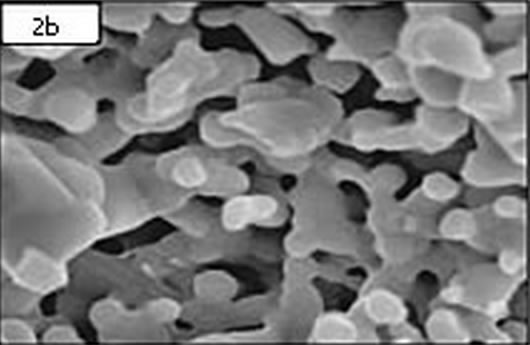
Fig. 2b: Microstructure of G-Fillinbone after 48 h of in vitro diffusion. Microporosities are empty.
Presentation
Sterile double-packed
Expiration date: 18 months after delivered
Store at a temperature < 25°C,
Use of gentamicin: Precautions and contra-indications consult manufacturer instructions.
TCP Fillinbone is a synthetic resorbable bone substitute composed of 100% ß (ß-TCP). It is manufactured in accordance with a system of quality assurance. Its similarity to mineral components of bones makes them perfectly biocompatible.
TCP Fillinbone bone substitutes are designed to fill in bone cavities or to increase bone amount. They can be used as a support for healing :
in case of loss of bone tissue (fracture, pseudarthrosis, arthroplasty repair),
for vertebral arthrodesis if the bone substitute is not under mechanical stress,
for maxillo-facial surgery,
for dental surgery: periodontal or apical filling;
implantology (sinus floor or alveolar crest augmentation, filling of osseous defects around implants).
Its synthetic origin prevents risks associated with transmission of pathogens, therefore guarantees a total safety.
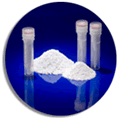
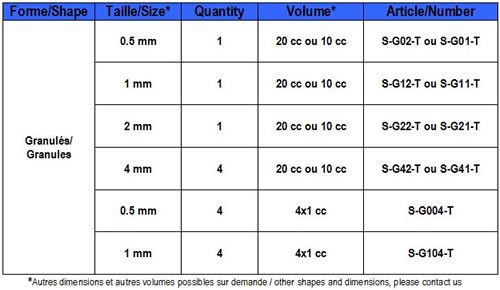
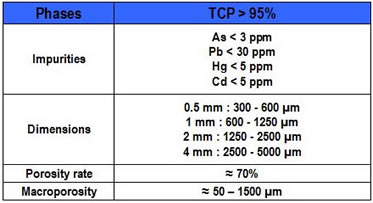
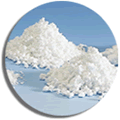
TCP Fillinbone comes in the shape of granules: 0.5, 1, 2 or 4 mm micro and macro-porous granules with a porosity ratio close to 70%.
Characteristics
The surface and interconnected porosity of TCP Fillinbone bone substitutes are optimised for bone ingrowth.
TCP Fillinbone bone substitutes are completely resorbable due to their tricalcium phosphate phase, thereby allowing for the replacement of the bone substitute by natural bone.
Atlantik synthetic bone substitute is manufactured in accordance with a system of quality assurance and has EC marking.
These bone substitutes consist of 70 % hydroxyapatite and 30 % ß tricalcium phosphate. The composition of the materials complies with the prevailing.
They are design to fill in bone cavities, specially in the following applications:
Joint prosthesis surgery
Vertebral surgery
Traumatology on closed fracture
Osteotomy
Filing after tumour resection
Maxillofacial
Dental
Atlantik bone substitutes are semiresorbable due to their tricalcium phosphate phase, thereby allowing for the partial replacement of the bone substitute by natural bone that will reinforce the long-term mechanical properties of the bone substitute.
Its synthetic origin prevents the risks associated with transmission of pathogens, therefore guarantees a total safety.
Atlantik bone substitute is available in 2 shapes:
Granules:0.5, 1, 2 or 4 mm micro and macro-porous granules
Blocks: Parallelepipeds, cylinders or corners with micro and macro-porosity (macropores: 500 µm). The compressive strength is around 10 MPa and the porosity ratio is 70%.
Characteristics
Atlantik bone substitutes have an optimised porosity and surface to induce fast bone ingrowth and good osteointegration.
Atlantik’s structure combines two different porosities. Macropores to induce the cell penetration and Micropores to increase the area in contact with the biological fluids.
The mechanical characteristics of the implants make them appropriate for most clinical indications
In vitro tests, animal implantation and clinical results show a perfect osteointegration of Atlantik Bone Substitutes.
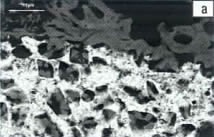
Picture A: Implantation in rabbit (3 months – Ulna)
100 μm histological section observed in microradiography. White: biomaterial Grey: mineralised bone tissue Black: non mineralised substances The mineralisation of bone tissue penetrating inside the porosities is equivalent to the mineralisation of the bone tissue surrounding the implant.
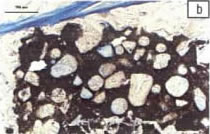
Picture B: Implantation in rabbit (3 months – Ulna)
50 μm histological section coloured with May-Grünwald-Giemsa Black: biomaterial Beige: mineralised bone tissue Blue: non mineralised cells and tissue Penetration of mineralised tissue inside the porosities of the biomaterial and beginning of the biodegradation of the biomaterial
Sterile double-packed
Stored at a temperature between 10° C and 40° C
Single use product, it should not be resterilised
Expiration date: manufacturing date + 5 years
Precautions and contraindications: please refer to the instructions of the manufacturer.